
Technical Factors That Shape a Successful Emergency Garage Door Repair Beverly Hills Response
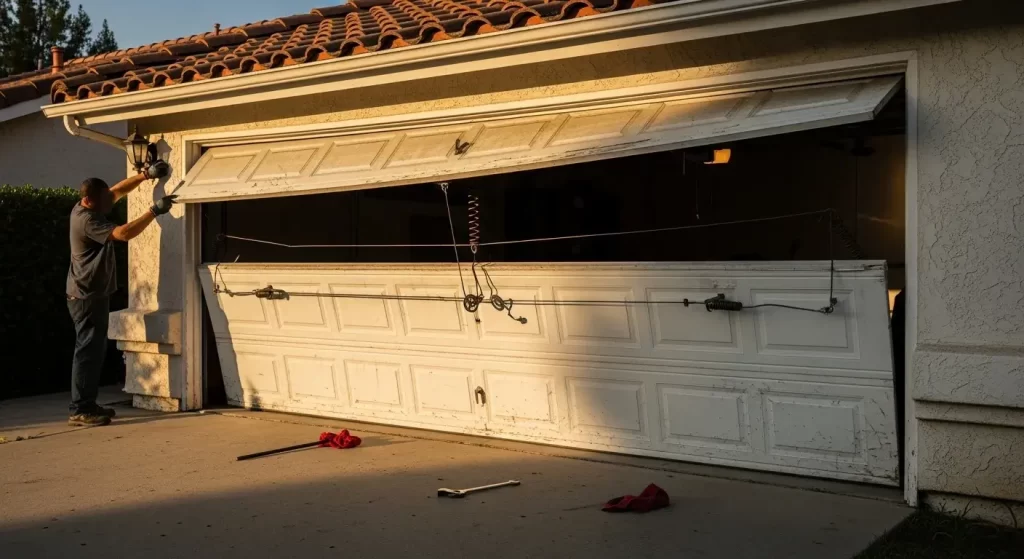
The Night an Emergency Call in Beverly Hills Changed the Way I Handle Every Repair
I’ve handled a lot of tough situations throughout my work with North Valley Garage Doors, but one emergency repair stands out more vividly than the others. This one didn’t happen in the middle of the day, with plenty of time and support. It happened at nearly midnight — the kind of hour when most people are asleep, and the last thing they want is a garage door problem.
The homeowner was panicked. They explained that their garage door had jammed halfway down, leaving the house exposed. Normally, that would be frustrating. But on this particular night, strong winds were rolling in from the canyon, rattling everything in sight. When I arrived, I immediately understood why they were scared — the heavy wooden sectional door was twisted at an angle, the right side hanging lower than the left. One cable had snapped. The drum on that same side had locked in place. And the torsion spring had lost tension from the sudden load imbalance.
Most people think “emergency garage door repairs” just mean hurrying to fix something. But what I learned that night, standing in that dimly lit Beverly Hills driveway, was that emergencies require more than speed — they require technical precision, emotional composure, and the ability to diagnose dozens of variables in seconds.
What saved that system wasn’t luck. It wasn’t just experience. It was the years I spent working in Pacoima, California, restoring old, misaligned, worn-out garage systems that had seen everything from heat warping to frame shifts. That background taught me a critical lesson I carry with me into every emergency garage door repair beverly hills call today:
In emergencies, the door is never the main problem — the hidden mechanics are.
Why Emergency Repairs Require a Completely Different Technical Approach
A scheduled repair gives you time.
An emergency repair gives you tension, risk, unpredictability — and the responsibility to correct everything without making a dangerous situation worse.
Emergency Conditions Do Not Forgive Mistakes
During scheduled repairs, I can take time to disassemble components methodically.
In emergencies, the door is often:
- Stuck
- Twisted
- Bowed
- Heavily imbalanced
- Supported by compromised hardware
- One wrong move away from collapsing
This is why an emergency garage door repair beverly hills job demands a higher level of awareness than any routine installation or tune-up.
Beverly Hills Homes Have Unique Technical Challenges
Many garages in Beverly Hills include:
- Heavy custom doors
- Oversized or insulated panels
- Full-view aluminum or glass designs
- High-cycle torsion systems
- Decorative facias
- Upgraded architectural framing
These features are beautiful — but when they fail, they fail dramatically.
Working in Pacoima, California, where systems are often older and less uniform, taught me to expect the unpredictable. That knowledge becomes invaluable during emergency repairs where heavy doors can shift suddenly, and safety risks escalate quickly.
The Counterintuitive Reality Behind Emergency Repairs
Most homeowners think the biggest risk in an emergency is the door falling.
But the truth is more complex — and far more dangerous.
The Real Danger Lies in Stored Energy, Not the Door Weight
A garage door is heavy, yes. But the torsion system stores hundreds of pounds of rotational energy. When something goes wrong:
- A cable snaps → the door twists violently
- A drum loses grip → cables unspool instantly
- A spring unwinds → metal lashes with enormous force
- A panel binds → weight distribution changes abruptly
In emergencies, this stored energy becomes unpredictable.
This is where my work in Pacoima, California taught me to respect torsion systems in a way that textbooks never covered. I’ve seen springs lose tension unevenly, drums warp under load, and cables fray after being dragged across metal during a failed cycle.
That experience taught me a critical truth I always share:
The most dangerous part of an emergency garage door repair beverly hills homeowners request isn’t the door itself — it’s what the hardware does when the balance is broken.
Technical Factors That Shape a Successful Emergency Response
Now let’s break down the core technical considerations I use on every emergency call for North Valley Garage Doors. These are principles developed from years of experience responding to dangerous, last-minute, unpredictable situations.
1. Rapid Structural Assessment Under Unstable Conditions
An emergency scenario means the garage door is no longer behaving normally. That alone makes the structure unstable.
Visual Structural Indicators
The first thing I evaluate is the environment:
- Tilted panels
- Warped tracks
- Shifted bearings
- Bowed shafts
- Swaying or vibration
- Loose brackets
- Crooked drums
In Santa Monica or Pacoima, these signs mean trouble — but in Beverly Hills, where doors tend to be heavier, these signs indicate serious structural risk.
Load Distribution Analysis
A twisted door redistributes its weight unpredictably:
- One side may be carrying 70% of the load
- Cables may tighten unevenly
- Tracks may pinch rollers
- Springs may be overextended
This is why I never touch the opener during emergencies. The opener can make the situation worse instantly if activated.
2. Stopping Instability Before It Spreads
Most emergency calls require stabilization before repair.
Manual Stabilization Techniques
I use:
- Temporary brackets
- Wooden wedges
- Vise grips on tracks
- Tension clamps
- Door braces
These support the door so it doesn’t drop unexpectedly while I work.
Neutralizing Remaining Stored Energy
This includes:
- Locking the torsion shaft
- Identifying spring fatigue
- Blocking roller movement
- Securing loose cables
In Pacoima, California, where old systems fail unpredictably, this step becomes second nature. During an emergency garage door repair beverly hills, this knowledge prevents injury and property damage.
3. Diagnosing the Source of Failure Under Pressure
In emergencies, the root cause isn’t always obvious.
Common Emergency Failure Points
- Snapped cables
- Broken springs
- Jammed rollers
- Misaligned tracks
- Bent panels
- Failed drums
- Opener arm dislocation
- Gear stripping
- Bearing plate separation
Hidden Failure Points Unique to Beverly Hills Homes
Luxury doors introduce new challenges:
- Insulation weight shifts
- Panel overlays separating
- Decorative trims interfering with tracks
- Miscalibrated smart openers
- Fatigue from high-cycle springs
This is where my hands-on experience in Pacoima, California helps me make fast decisions. Homes in Pacoima taught me never to trust what I see at first glance — the real issue is usually hidden.
4. Safe Decompression of the Torsion System
One of the most dangerous parts of emergency work is unwinding or resetting springs when they are not in a normal load state.
Controlled Unwinding Technique
Using winding bars, I decompress the springs:
- One quarter-turn at a time
- Maintaining constant downward pressure
- Monitoring shaft torque
- Listening for metal stress signals
- Watching cable movement
The Risk of Asymmetrical Tension
Emergency scenarios often involve:
- One spring carrying too much load
- One drum locked while the other spins
- Cables under uneven tension
- Offset shaft behavior
Even veteran technicians take this step slowly, deliberately, and with full attention.
5. Rebuilding Stability Before Any Final Repair
Once the system is safe, I begin rebuilding stability.
Straightening Panels or Removing Them
Depending on severity, I may:
- Reset panel alignment
- Remove twisted sections
- Support sagging panels
- Reinforce attachment points
Realigning Tracks Under Load
Tracks must be:
- Square
- Even
- Vertical
- Parallel
- Molded to the exact radius
Emergency impacts often warp tracks subtly, and improper alignment will simply recreate the emergency later.
Restoring the Mechanical System After Stabilization
After the door has been secured, the tension neutralized, and the major risks contained, the next phase is rebuilding the mechanical integrity of the system. This stage requires patience, precise technical judgment, and an understanding of how every component interacts under strain.
What many homeowners don’t realize is that even a seemingly small emergency — like a broken cable — often creates multiple cascading failures. In heavier doors commonly found in Beverly Hills, the stress shifts instantly across the system, leaving behind invisible damage that will cause failure again if not addressed thoroughly.
It’s here that my experience working on complex, inconsistent, and aging systems throughout Pacoima, California becomes incredibly valuable. When you grow accustomed to handling doors that have already lived hard lives, you learn how to spot the subtle signs of stress that most technicians miss.
6. Cable Replacement and Tension Synchronization
Cable failure is one of the most common causes of emergency calls. But replacing the cable is only step one — the real challenge is restoring perfect tension integrity.
Understanding Emergency Cable Behavior
When a cable snaps:
- The door twists
- The load shifts to one side
- The drum on the functioning side takes excessive stress
- The torsion shaft bends microscopically
- Rollers can pop out of their track pockets
- The opener arm may twist or warp
A quick cable replacement fixes none of that.
Drum Re-centering and Cable Wrap Correction
To repair the system properly, I:
- Clean the drum grooves
- Re-center the shaft
- Re-seat the cable onto the drum’s proper channel
- Tighten set-screws with calibrated torque
- Perform slow lifts to guarantee symmetry
Any uneven wrap — even one layer out of sync — causes grinding, fraying, and leaning.
Symmetry Testing
I test cable tension by:
- Manually lifting the door
- Listening for cable “pluck” tension
- Checking roller travel
- Comparing drum resistance
- Evaluating spring recoil response
This method was refined during countless repairs in Pacoima, California, where cables frequently failed under uneven load conditions.
7. Repairing or Replacing Damaged Rollers and Tracks
During emergencies, the rollers often take a beating they were never designed to endure.
Roller Evaluation
I inspect:
- Stem straightness
- Wheel cracking
- Bearing resistance
- Axial looseness
- Pin distortion
If even one roller shows signs of stress, noise, or wobble, it compromises the entire system.
Track Realignment Under Post-Emergency Conditions
Tracks bent or warped by a twisted door must be corrected with:
- Controlled leverage
- Track gauge tools
- Micro-bending methods
- Anchor re-spacing
- Lateral trueing
A millimeter of track deviation in Beverly Hills luxury doors can create scraping, vibration, and sticking that multiply over time.
Ensuring Vertical and Horizontal Track Harmony
I verify:
- Perfect plumb on vertical tracks
- Proper pitch on horizontal tracks
- Correct radius curvature
- Even bracket spacing
- Matching left-right geometry
These adjustments ensure the door doesn’t bind under weight.
8. Spring System Diagnostics and Recalibration
Most emergency situations impact the torsion system, even if the springs themselves haven’t broken. A cable failure, panel twist, or roller derailment often changes the entire torque distribution.
Identifying Hidden Spring Damage
Springs may exhibit:
- Micro-fractures
- Uneven gaps
- Fatigue deformation
- Loss of coil elasticity
- Surface scoring
- Imbalanced winding tension
Unexpected load changes during emergencies can weaken springs dramatically.
Controlled Re-Tensioning
I recalibrate:
- Quarter-turn torque application
- Balanced load distribution
- Center bearing alignment
- Shaft rotational smoothness
If a spring has been overstretched during failure, recalibration becomes a delicate manual process — a skill sharpened through years of handling unstable doors throughout Pacoima, California.
When Replacement Is Necessary
If the coil shows:
- Separation
- Sharp cracking
- Elongated coil spacing
- Pronounced rusting
- Uneven load response
Then the spring must be replaced regardless of age.
Emergency strain accelerates spring failure.
9. Opener Arm, Bracket, and Gearbox Assessment
Openers often suffer damage during emergencies, even if the door itself didn’t strike them directly.
Opener Arm Geometry Reset
A twisted or compressed opener arm must be:
- Straightened
- Re-angled
- Re-fastened
- Torqued correctly
- Aligned with travel arc
If the arm geometry is off, the door:
- Jerks
- Pulses
- Vibrates
- Strains the opener
- Threatens the track system
Header Bracket Reinforcement
Emergencies loosen brackets, causing:
- Wall flex
- Vibration transfer
- Loud popping
I often reinforce brackets by:
- Reanchoring into structural studs
- Installing additional support plates
- Using deeper fasteners
- Ensuring true centerline positioning
Gearbox Inspection
Forced loads during emergencies can strip opener gears.
I check:
- Motor resistance
- Travel consistency
- Chain/belt tension
- Idler pulley smoothness
- Internal gear noise
A failing gearbox must be addressed immediately.
10. System Rebuild and Final Alignment
Once every damaged component is repaired or replaced, I begin the system rebuild.
Global Alignment Finalization
This includes:
- Track trueing
- Drum balancing
- Roller distribution
- Shaft leveling
- Spring tuning
- Opener harmony calibration
Multi-Side Pressure Testing
I test:
- Left-right lift strength
- Equal descent speed
- Panel pressure equality
- Symmetrical movement across cycles
Door Behavior Under Different Loads
I simulate:
- Slow lifts
- Fast lifts
- Manual operation
- Emergency release action
The door must remain stable under all conditions.
The Deep Technical Principles Behind a Successful Emergency Repair
After years of handling emergency calls across Los Angeles — including complex systems in Beverly Hills — I’ve realized that success depends on mastering five core principles.
1. Structural Awareness
Understanding:
- Frame weaknesses
- Material interaction
- Load paths
- Anchor integrity
This determines whether the repair will last.
2. Counterbalance Precision
Spring systems must be:
- Equalized
- Calibrated
- Tested
- Retested
The opener relies entirely on spring balance.
3. Component Synchronization
Drums, cables, shafts, and rollers must move as a unified structure.
4. Environmental Adaptation
Beverly Hills homes may require:
- Corrosion-resistant hardware
- Adjusted lubrication cycles
- Temperature-specific calibration
- Reinforcement against wind pressure
5. Installer Intuition
No manual teaches intuition.
I gained mine from difficult repairs throughout Pacoima, California, where doors often arrived warped, unbalanced, or patched over.
That intuition is what allows me — and North Valley Garage Doors — to handle emergency situations with accuracy and confidence.
Why Beverly Hills Homeowners Benefit From a Pacoima-Level Skillset
It might sound strange at first, but experience in Pacoima, California is precisely why our team excels during high-pressure emergency calls in Beverly Hills.
Pacoima taught us to:
- Expect the unexpected
- Diagnose subtle mechanical shifts
- Repair older, inconsistent systems
- Understand system behavior under stress
- Solve problems where conditions are imperfect
These skills translate perfectly into the unpredictable nature of an emergency garage door repair beverly hills scenario.
Where luxury homes expect perfection, Pacoima taught us resilience.
Where heavy doors introduce risk, Pacoima taught us caution.
Where emergencies demand instinct, Pacoima taught us awareness.
The fusion of these two worlds is what makes North Valley Garage Doors uniquely qualified for emergency work in Beverly Hills.
Final Thoughts — Emergency Repairs Are About Control, Not Speed
Emergency garage door repairs are chaotic only when the technician lacks control.
A professional repair is:
- Calm
- Technically sound
- Methodical
- Safe
- Precise
- Thorough
A successful emergency garage door repair beverly hills job is built on:
- Stabilizing
- Diagnosing
- Decompressing
- Rebuilding
- Rebalancing
- Synchronizing
- Educating the homeowner
And behind every successful repair is the experience gained from years of handling the toughest systems in Pacoima, California, where nothing was ever straightforward, and every repair demanded full awareness.
In the end, true emergency expertise isn’t defined by how quickly someone arrives — it’s defined by how safely and expertly the problem is resolved.