
Technical Considerations That Ensure a Smooth Garage Door Installation Santa Monica Experience
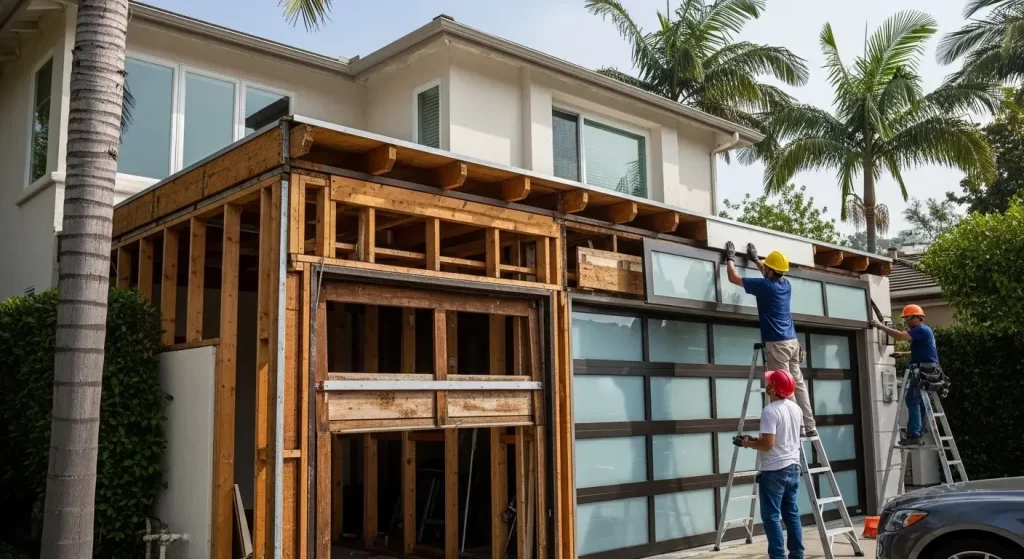
The Installation That Showed Me How Much Technical Precision Really Matters
I’ll never forget one particular installation early in my career, long before North Valley Garage Doors became known for complex projects in places like Santa Monica. Back then, most of my experience came from working in older homes around Pacoima, California, where garages often leaned a little, floors sloped more than homeowners realized, and framing wasn’t always as cooperative as you’d hope. These conditions forced me to develop a level of precision that wasn’t optional — it was survival.
One day, I arrived at a job where a homeowner insisted their garage was “totally level and ready for installation.” It wasn’t. The floor had a slight slope — just under half an inch from left to right. That tiny variation changed everything: track alignment, panel compression, seal engagement, and—most importantly—the long-term balance of the door. If I had ignored it, the door would have operated fine for a few months and then slowly begun binding on one side, stressing the opener until it eventually failed.
That experience shaped the way I approach every garage door installation santa monica project today. Santa Monica properties are often beautifully constructed but deceptively complex. Perfect finishes hide structural quirks. Decorative fascias mask uneven framework. And because I learned to work through the unpredictable conditions of Pacoima, California, I bring a level of technical sensitivity that makes all the difference.
Why Garage Door Installation in Santa Monica Requires a Technical Mindset
Santa Monica is known for its coastal climate, luxury finishes, and architectural diversity. What most homeowners don’t realize is that all these factors influence how a garage door must be engineered, calibrated, and installed.
Coastal Climate Changes Everything
The marine layer, salty air, and moderate humidity levels in Santa Monica create conditions that impact:
- Hardware corrosion rates
- Spring fatigue cycles
- Panel material selection
- Lubrication requirements
- Sensor stability
- Track oxidation
By contrast, Pacoima, California experiences dry heat. This means a technique that works perfectly in Pacoima might degrade more quickly in Santa Monica’s coastal environment unless the installer understands how to compensate.
This is why North Valley Garage Doors always adjusts materials, coatings, and calibrations specifically for coastal homes.
Architectural Styles Affect Track and Header Geometry
Santa Monica homes commonly feature:
- Custom garage openings
- Decorative retrofits
- Stucco transitions
- Narrow overhead clearances
- Integrated soffits
- Varying header heights
Unlike the more straightforward framing structures typical in many parts of Pacoima, California, Santa Monica garages often require:
- Non-standard track pitch
- Custom bracket reinforcement
- Modified anchor placements
- Variable tension adjustments
- Special opener rail orientation
Even a ⅛-inch misalignment becomes a problem in these environments.
Luxury Doors Require Engineering, Not Just Installation
High-end doors — especially insulated, full-view aluminum, or custom wood — are significantly heavier than standard steel panels.
This impacts:
- Torsion spring wire gauge
- Torque distribution
- Cable thickness
- Drum diameter
- Bearing load
- Shaft deflection
- Opener force settings
A garage door installation santa monica project is never just about fitting a door into an opening; it’s about engineering the system to operate flawlessly under coastal, architectural, and weight-specific influences.
The Counterintuitive Insight Most Homeowners Never Consider
Most people assume the door is the star of the show. They think reliability comes from the quality of the panels, the insulation, or the opener’s horsepower.
But the truth is far more counterintuitive:
The Most Important Part of the System Is the Balance — Not the Opener
A properly installed garage door should lift effortlessly by hand.
If it doesn’t, the opener is doing too much work.
Here’s what that means:
- A door that feels heavy isn’t balanced.
- A door that won’t stay in place halfway is mis-calibrated.
- A door that rises too quickly is spring-overloaded.
- A door that binds on one side has uneven cable tension.
- A door that shakes is losing track alignment.
The opener should only guide the door, not lift it.
This is something I learned repeatedly while working on challenging homes in Pacoima, California, where many systems were old, patched, worn, and required precise adjustment to function correctly.
When we bring North Valley Garage Doors into a garage door installation santa monica project, we’re not just installing a door — we’re ensuring the opener will last years longer simply because the mechanics are balanced correctly.
Technical Considerations That Ensure a Smooth Installation
A smooth installation is not an accident. It’s the result of meticulous planning, engineering awareness, and years of real-world experience.
Below are the most important technical factors that define a reliable garage door installation santa monica project.
1. Structural Alignment and Load Evaluation
Before any installation begins, I analyze the structure:
Header Stability
The header must withstand dynamic and static loads.
I evaluate:
- Reinforcement
- Material composition
- Anchor depth
- Header bow or sag
- Hidden cracks
Santa Monica homes often hide imperfections behind beautiful finishes. Years working in Pacoima, California taught me how to detect subtle structural flaws quickly.
Side Jamb Integrity
Side jambs must be:
- Vertically true
- Structurally anchored
- Free from voids
- Suitable for load-bearing
- Evenly spaced
Uneven jambs lead to track stress.
Floor Level Verification
Santa Monica garages often use:
- Decorative concrete
- Sloped entries
- Polished finishes
Even slight leveling deviations influence the door’s travel.
2. Panel Placement and Joint Engineering
Each panel must be:
- Square
- Level
- Aligned laterally
- Seated correctly
- Secured without torque distortion
Joint Compression Matters More Than Most Installers Think
Improper joint compression creates:
- Gaps
- Binding
- Roller misalignment
- Seal inconsistencies
- Air leaks
I use:
- Digital leveling tools
- Compression feel techniques
- Multi-panel calibration
- Roller orientation adjustments
These details matter, especially for heavier coastal doors.
3. Track Pitch Engineering and Geometric Calibration
Track installation determines:
- Silence
- Smoothness
- Stability
- Safety
- Opener longevity
Standard Pitch Is Almost Never Ideal
Most installers use a generic pitch ratio:
- ¼ inch rise per foot
But for a garage door installation santa monica, I consider:
- Door weight
- Panel thickness
- Climate influence
- Opener speed
- Headroom limitations
- Roller composition
In some Santa Monica garages, the correct pitch is slightly steeper to prevent salt-air-induced drag from slowing the door.
In others, it must be shallower to maintain clearance near coastal breezeways.
4. Torsion System Engineering — The True Heart of the Door
The torsion system determines everything:
- Balance
- Safety
- Effort
- Wear
- Opener load
- Long-term reliability
Precise Spring Selection
I match spring dimensions based on:
- IPPT (inch-pounds per turn)
- Door weight (including overlays)
- Door height
- Material type
- Desired cycle rating
- Drum size
I learned to respect torsion physics while working on the uneven, unpredictable systems in Pacoima, California, where no door ever behaved the same way twice.
Micro-Torque Calibration
I tension springs using:
- Quarter-turn increments
- Multi-height balance testing
- Load symmetry measurement
- Noise-feedback analysis
A quarter turn too much or too little changes everything.
5. Drum, Cable, and Shaft Synchronization
Once the torsion system is set, synchronization ensures smooth operation.
Drum Alignment
I align drums so:
- They rotate freely
- Cable wraps evenly
- Tension matches on each side
- Lateral drift is eliminated
- Vibration is minimized
Cable Tension Consistency
If tension differs by even a few pounds:
- Door leans
- Tracks wear unevenly
- Rollers wobble
- Opener gets stressed
- Door seals unevenly
Shaft Straightness
Even a slight bend causes:
- Noise
- Vibration
- Drum misalignment
- Cable stretch
This is especially important in Santa Monica homes with oversized or insulated doors.
Fine-Tuning the Mechanics for Long-Term Stability
Every technical step leading up to this point builds the foundation, but it’s the fine-tuning phase that transforms a simple installation into a truly reliable garage door installation santa monica experience. This part of the process is delicate, deliberate, and requires more than simple mechanical skill — it requires a technician with intuition sharpened by years of solving complex problems.
This is where my background working in Pacoima, California becomes invaluable. Pacoima garage systems rarely arrive in a perfect state. Many frames are older, many springs have been mismatched over the years, and many openers were installed incorrectly long before I arrived. Learning to diagnose and correct all these issues gave me the kind of mechanical instincts that cannot be taught in a classroom.
Applying that level of intuition to Santa Monica’s higher-end doors helps me ensure each system operates flawlessly under coastal conditions and architectural constraints.
6. Opener Calibration and Mechanical Harmony
When the mechanical components are aligned, balanced, and synchronized, only then do I integrate the opener. The opener should never be used as a crutch for mechanical flaws. It should be the final partner in a perfectly balanced system.
Rail Stabilization and Load Control
The opener rail must be:
- Perfectly straight
- Properly supported
- Free from flex
- Anchored into structural members
- Spaced evenly
Even slight sag in the rail introduces unnecessary resistance and causes the trolley carriage to fight the door’s weight instead of guiding it.
Arm Geometry Optimization
The arm connecting the opener to the door must be:
- Set at the correct angle
- Positioned for smooth force distribution
- Tightened with calibrated torque
- Adjusted for door travel curvature
Improper opener arm positioning is one of the most common mechanical flaws I correct — especially in Santa Monica homes where installers focus more on aesthetics than biomechanics.
When the arm geometry is wrong, the opener experiences:
- Shuddering
- Drag
- Noise
- Premature gear failure
- Chain/belt tension loss
North Valley Garage Doors never leaves this to chance.
Smart Technology Setup
Santa Monica homeowners commonly request advanced smart features:
- Wi-Fi integration
- Cloud monitoring
- Camera-enabled openers
- Remote activity logging
- App-based notifications
- Automated schedules
These systems require precise setup because coastal signal interference, wall thickness, and metal framing can disrupt connectivity.
Knowing how to diagnose and position hardware for these systems comes from years of adapting installations to challenging conditions across Pacoima, California.
7. Multi-Stage Balance Testing and Load Verification
Perfect balance is the single most important factor in garage door longevity.
A balanced door protects the opener, the tracks, the rollers, the springs — and the homeowner’s safety.
I test balance in three distinct phases:
25% Open — Initial Lift Check
This reveals:
- Spring preload accuracy
- Shaft alignment
- Cable distribution
- Roller friction
If the door rises too quickly, the springs are overloaded.
If it sinks too quickly, they’re underloaded.
50% Open — True Neutral Balance Zone
This is the “truth moment.”
If the door does not stay suspended here, the torsion system is not properly calibrated.
The neutral point test is one of the first balance techniques I mastered working in Pacoima, California, where uneven structures demanded absolute precision.
75% Open — High-Lift Stress Testing
This reveals:
- Drum integrity
- Cable spacing
- High-end shaft behavior
- Track vibration under reduced load
A door might pass the 50% test but still fail here due to:
- Drum defects
- Cable slip
- Shaft bow
- Roller bind
- Track sway
Each test helps refine micro-adjustments for flawless operation.
8. Track Stability Testing, Vibration Mapping, and Acoustic Diagnostics
High-end garage doors must operate quietly, smoothly, and consistently — all of which require more than basic installation skills. They demand technical awareness and precise diagnostic methods.
Vibration Transfer Mapping
Using touch and sound, I analyze:
- Header vibration
- Bracket resonance
- Shaft oscillation
- Track hum
- Bearing chatter
These vibrations often begin subtly, then grow louder over months if not corrected.
In Santa Monica, where garages may share walls with living areas or home offices, vibration control is essential.
Track Stress Response Under Cyclic Load
I open and close the door multiple times to evaluate:
- Horizontal track sway
- Vertical track torque
- Roller tracking path
- Panel glide consistency
- Opener load variance
Repeated cycles reveal issues hidden during a single open-close movement.
Acoustic Signatures and Mechanical Noise Profiles
I listen for:
- Roller rumble
- Spring “ping” resonance
- Drum scratching
- Cable friction
- Shaft humming
- Bearing growl
My years diagnosing older, inconsistent systems in Pacoima, California trained my ear to detect anomalies homeowners would never notice until they become serious.
9. Safety System Validation and Sensor Optimization
A smooth installation is not complete until safety is verified and optimized.
Photo-Eye Alignment
I calibrate sensors using:
- Laser alignment tools
- Obstruction path mapping
- Sun-interference testing
- Reflective floor compensation
Santa Monica’s coastal light glare often interferes with photo-eyes, so angle adjustments must be carefully executed.
Force Sensitivity Calibration
I test:
- Down-force values
- Auto-reverse thresholds
- Emergency stop behavior
- Motor resistance tolerance
A safe door reverses instantly upon detecting resistance, not after applying excessive pressure.
Safety Redundancy Checks
I validate:
- Emergency rope detachment
- Backup battery function
- Limit switch accuracy
- Manual operation ease
These details are essential, especially in luxury homes where children, pets, and vehicles require precise safety margins.
10. Homeowner Education and System Orientation
Even the best installation benefits from homeowner understanding.
North Valley Garage Doors always ensures homeowners feel confident using their system.
I explain:
- How to test balance monthly
- How to clean tracks properly
- What sounds indicate early problems
- How to maintain weather seals
- How to reset openers after power outages
- When to call for maintenance
- How to identify cable wear
- How to manually override in emergencies
In Santa Monica — where garages often double as storage, gyms, or living extensions — this knowledge becomes essential.
Why Our Pacoima Roots Give Us an Edge in Santa Monica
Some people assume that experience in high-end environments alone makes a great installer.
But the truth is the opposite.
Working in Pacoima, California taught us:
- How to deal with unpredictable structures
- How to correct decades of improper wiring
- How to overcome poor framing
- How to repair uneven shafts and misaligned doors
- How to identify structural issues behind drywall
- How to solve real-world, imperfect conditions
This foundation makes North Valley Garage Doors uniquely qualified for complex garage door installation santa monica projects, where homes are beautiful on the outside but often hide technical challenges behind finishes.
Reliability Begins in Imperfect Conditions
The toughest lessons didn’t come from working on luxury homes.
They came from:
- Rusted angle brackets
- Warped tracks
- Misaligned framing
- Cracked headers
- Improvised reinforcement
- Aged torsion systems
Solving these issues daily in Pacoima, California gave us a calibration instinct that translates directly into high-end Santa Monica installations.
The Elements That Truly Make an Installation Smooth
After thousands of installations, I’ve learned that four elements determine everything:
1. Structural Alignment
The frame must be capable, strong, even, and resistant.
2. Mechanical Balance
Springs, cables, drums, and shafts must work as one.
3. Geometric Precision
Tracks, panels, brackets, and opener arms must be perfectly aligned.
4. Environmental Adaptation
Coastal environments demand material and calibration adjustments.
Final Thoughts — Smoothness Is Engineered, Not Assumed
A truly smooth garage door installation santa monica experience isn’t luck.
It doesn’t come from having fancy tools or expensive doors.
It comes from:
- Precision
- Awareness
- Engineering knowledge
- Structural understanding
- Balance mastery
- Experience under pressure
Every lesson I learned in Pacoima, California contributes to the way I approach complex installations today. Santa Monica homeowners deserve a door that glides, not struggles — a door that lasts, not deteriorates — and a door that operates silently, not unpredictably.
And when every component is aligned, calibrated, synchronized, and engineered correctly, a garage door becomes more than a system — it becomes a reliable, long-lasting part of the home.