
Essential Elements Behind a Reliable North Valley Garage Door Installation Beverly Hills Homeowners Trust
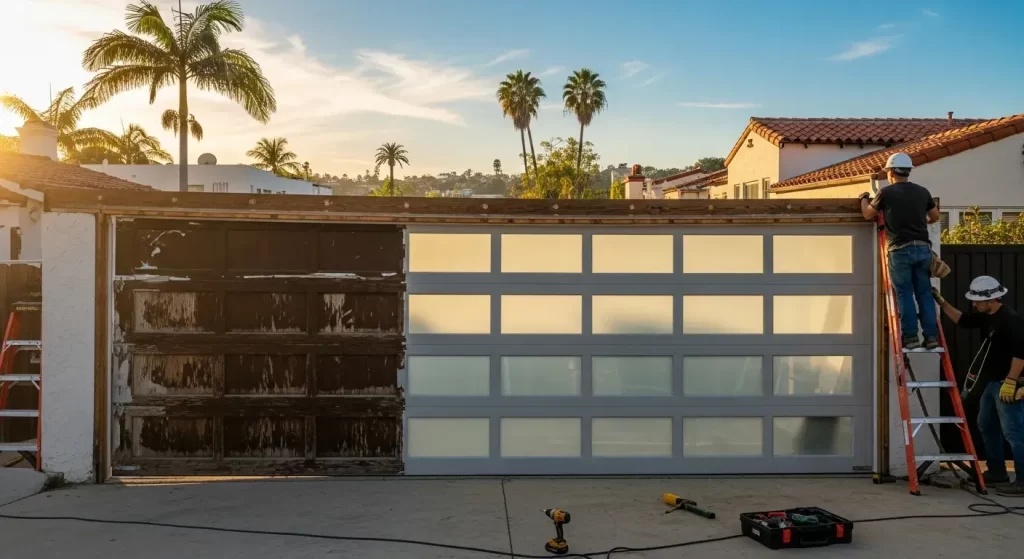
The Installation That Redefined What “Reliable” Really Means
If there’s one lesson that has shaped the way I handle every installation for North Valley Garage Doors, it came from a project that wasn’t actually in Beverly Hills — it began right in Pacoima, California, where our company has its roots and where I learned how to solve problems under pressure. Years ago, long before high-end installations became routine, I was called to fix a garage door that had collapsed partially off its track. The door wasn’t old, wasn’t damaged, and hadn’t been struck. It simply failed because of a mistake most homeowners — and unfortunately, many installers — never think about.
The original technician had matched the springs to the door’s weight, but not to its true load distribution. The left side of the door had a decorative overlay that added about 14 extra pounds of weight to that section alone. It doesn’t sound like much, but when I disconnected the opener and began a manual balance test, the door crawled upward on one side and felt heavy on the other. That subtle imbalance had gone unnoticed for nearly a year — until the opener finally gave up.
What I learned that day shaped everything I do today, especially when handling a garage door installation beverly hills project. It taught me that a reliable installation is never about how strong or beautiful the door looks. A reliable installation is one where every hidden component — every spring, bracket, drum, track angle, and load-bearing point — works in complete harmony.
And that is the mindset I bring into every installation North Valley Garage Doors completes in Beverly Hills, even though our team comes from the hardworking streets of Pacoima, California, where precision was something we had to master out of necessity.
Why Reliability Starts Long Before the Door Is Installed
Most people think reliability comes from sturdy materials and a good opener. But the truth is far more complicated — and far more interesting.
A truly reliable garage door installation beverly hills homeowners can trust begins long before a single panel is lifted. It starts with engineering, load calculations, site evaluation, and identifying weaknesses that the homeowner doesn’t even know exist yet.
The Structural Variables Most Installers Never Check
Before I begin any installation for North Valley Garage Doors, I evaluate elements that many technicians simply overlook:
1. Header Strength and Material Type
In Beverly Hills, headers may be decorative, hidden behind custom facades, or structurally integrated into architectural features.
I check for:
- Internal cracking
- Bowing under existing loads
- Stucco separation
- Faulty original hardware
- Weak framing behind luxury finishes
This step is essential because a header that looks solid from the outside can be dangerously weak behind the surface — something I learned repeatedly while working on older homes in Pacoima, California.
2. Side Jamb Integrity
Side jambs must carry vertical loads evenly.
I verify:
- Stud anchoring
- Vertical alignment
- Hidden voids
- Old repairs or patches
- Drywall inconsistencies
Without this baseline, the track system cannot sit correctly — and that alone can compromise the entire installation.
3. Floor Levelness and Seal Compression
Even a slight slope can affect:
- Door travel
- Bottom seal compression
- Weatherproofing
- Panel alignment
On one particular high-end job, I found a ⅜-inch slope across a 12-foot span — imperceptible visually but enough to strain the opener cycle after cycle.
The Counterintuitive Reality: The Opener Is the Least Important Factor
Here’s something most homeowners get wrong — and I don’t blame them because the opener looks like the centerpiece of the entire system:
The Opener’s Job Is Not to Lift the Door
It’s only meant to guide it.
If your door cannot be lifted smoothly and evenly with one hand, something is unbalanced — and the opener is being abused. In a proper garage door installation beverly hills, the opener should be lifting no more than a few pounds of true mechanical load.
What does that mean for reliability?
It means the opener is only as reliable as:
- The torsion spring calibration
- The track pitch
- The cable tension
- The drum alignment
- The shaft straightness
- The door’s weight distribution
This insight wasn’t something I learned through manuals.
It came from years of working with older, unpredictable systems in Pacoima, California, where doors were rarely perfectly balanced and where I had to learn to identify the smallest mechanical inconsistencies.
Essential Engineering Principles Behind a Reliable Installation
A high-end garage door installation beverly hills homeowners can trust requires a level of engineering that goes far beyond simply “hanging panels.” Here are the core principles North Valley Garage Doors uses — principles built through years of hands-on experience serving our community in Pacoima, California and the larger Los Angeles area.
1. Precision Panel Installation — The Foundation of Reliability
Most installers rush this part, but panel alignment determines:
- Smooth operation
- Even joint compression
- Roller alignment
- Door longevity
- Opener strain levels
Laser-Level Accuracy
I install each panel using:
- Digital inclinometers
- Laser leveling systems
- Multi-point compression checks
- Roll-in clearance measurements
Even a 1/8-inch deviation can cause scraping, track stress, or motor strain later.
Joint Compression Control
The joints between panels must align perfectly or the entire structure becomes unstable. I verify:
- Pin alignment
- Seal compression
- Lateral drift resistance
- Roller pocket reinforcement
This level of detail is why our installations, even the heaviest ones, operate silently and reliably over time.
2. Track Engineering — The Most Underestimated Component of All
Track installation isn’t just about attaching metal rails.
It is a geometric alignment process.
Track Pitch Calibration
Standard installers follow a generic guideline:
¼ inch rise per foot of horizontal track.
But for high-end doors — especially those installed in Beverly Hills — this is rarely correct.
I adjust track pitch based on:
- Door weight
- Spring torque
- Roller type
- Opener horsepower
- Headroom space
- Frame material
The difference between a door that glides and a door that shudders often comes down to pitch accuracy.
Horizontal Track Suspension Stability
Tracks must be suspended so they:
- Don’t sway
- Don’t flex
- Don’t vibrate
- Don’t pull against the header bracket
This stability determines long-term reliability and noise levels.
3. Torsion System Engineering — The Heart of the Installation
This is where reliability is truly made.
Spring Selection Based on Exact Door Weight
Most installers “approximate” spring size.
We do not.
I determine:
- Exact door weight
- Distribution patterns
- Material density
- Overlay additions
- Insulation weight
- Panel reinforcement loads
I then match:
- Wire diameter
- Inner diameter
- Coil count
- Spring length
- Desired cycle rating
This level of accuracy ensures that the springs do the lifting — not the opener.
Torque Calibration in ¼-Turn Increments
This is the step that most directly influences long-term reliability.
I calibrate spring torque in precise quarter-turns, checking:
- Lift pressure
- Balance at multiple heights
- Static equilibrium
- Descent uniformity
This is one of the most critical stages of any garage door installation beverly hills project.
4. Cable & Drum Configuration — The Silent Source of Reliability
You cannot have reliability without perfect cable work.
Drum Positioning and Set-Screw Torque
I align the drums so that both sides:
- Carry identical load
- Rotate without lateral drift
- Maintain clean cable tracking
If the drum tilts or binds, the entire system destabilizes.
Cable Tension Synchronization
I ensure cables are:
- Even
- Taut
- Cleanly wrapped
- Free from fraying
- Resistant to shear
A door lifting unevenly by even ¼ inch indicates a serious tension inconsistency.
5. Shaft Stability and Bearing Alignment
Stability is what ensures the system doesn’t shake, grind, or develop excessive noise.
Shaft Straightness Verification
Luxury doors often require heavy shafts — and even slight bends create:
- Vibration
- Uneven drum rotation
- Cable wear
- Structural stress
Using bearing plates and digital levels, I verify perfect shaft integrity.
The Final Engineering Stages That Guarantee Long-Term Reliability
Everything in the first half of the installation — the structural evaluation, panel alignment, track geometry, torsion system engineering, drum calibration, and cable work — builds toward what I consider the “final stage” of reliability. This stage is where a system becomes more than functional. This is where it becomes something a homeowner can trust for years without thinking about it.
Many of these final steps are invisible to the homeowner. They have nothing to do with how the door looks and everything to do with how the door behaves. And this is where North Valley Garage Doors draws from decades of experience in Pacoima, California, applying those lessons to every high-end garage door installation beverly hills homeowners entrust us with.
Step 6 — Opener Integration and Load Harmony
By the time I attach the opener, the door should already be operating flawlessly. In fact, I always test the door manually before installing the opener — because if the door doesn’t balance perfectly by hand, no opener in the world will compensate for that imbalance.
Opener Rail Precision
The opener rail must be perfectly straight and properly supported. A sagging rail introduces unnecessary friction, misalignment, and long-term stress.
I verify:
- Rail linearity
- Rail-to-header alignment
- Motor mount tension
- Arm geometry
- Bracket reinforcement
The opener must work in harmony with the door, not against it.
Arm Geometry and Force Distribution
One of the most overlooked aspects of reliability is the opener arm angle. If the arm is positioned incorrectly:
- The door jerks at startup
- Panels flex
- Tracks shake
- Noise increases
- Strain is amplified onto the motor
A correct arm angle produces:
- Smooth initial lift
- Even pressure distribution
- Reduced friction on rollers
- Quieter operation
This is especially important during garage door installation beverly hills where homeowners expect near-silent operation.
Smart Features and Automation
Beverly Hills installations often integrate advanced systems, including:
- Wi-Fi openers
- App controls
- Smart home hubs
- Cameras
- Auto-close timers
- Motion sensors
I ensure the system communicates properly and doesn’t interfere with other wireless devices. These environments require careful configuration to minimize signal interruptions.
Step 7 — Three-Level Balance Testing
Balance testing is the most important indicator of long-term reliability.
A door can look beautiful, move smoothly for a week, and still be fundamentally flawed.
Only balance testing exposes the truth.
I test the door at:
Level 1 — 25% Open
The door should pause gently when released, without drifting or accelerating.
This tests spring preload accuracy.
Level 2 — 50% Open (Neutral Zone)
This is the true balance test.
If it:
- Rises on its own → springs overtightened
- Falls on its own → springs undertightened
- Stays suspended → perfect
In Pacoima, California, older doors constantly failed this test, which taught me how to correct balance issues in just a few seconds by adjusting torque micro-turns.
Level 3 — 75% Open
This reveals:
- Shaft friction
- Cable elasticity
- Drum inconsistencies
- Roller drag
If the door hesitates or “pulses,” something is misaligned.
Step 8 — Track Stress Testing and Acoustic Diagnostics
I perform a series of load and sound evaluations. This is where years of experience guide me more than any tool ever could.
Vibration Transfer Analysis
I check whether vibration:
- Transfers into the header
- Resonates down the tracks
- Travels into the motor
- Creates harmonic noise
Most installers ignore resonance.
I don’t — because resonance always becomes noise later.
Track Stress Under Cyclic Load
I test:
- Side-loading behavior
- Track flex
- Horizontal track sway
- Vertical track torque response
If the tracks shift even slightly during opening, the long-term stability is compromised.
Sound Profiling
I listen for:
- Roller frequency
- Cable drag
- Drum breathing sounds
- Shaft hum
- Panel rumble
- Bearing resonance
This technique was born from my early days working in Pacoima, California, where every garage was different and sound diagnosis was often more reliable than visuals.
Step 9 — Safety System Testing and Sensor Verification
Safety cannot be compromised — especially for Beverly Hills homes where families expect absolute reliability.
Sensor Calibration
I:
- Align photo-eyes with laser tools
- Check sun interference patterns
- Adjust mounting height
- Test obstruction response
- Evaluate false-trigger sensitivity
Sun glare is a major issue in Los Angeles homes with polished flooring, and Beverly Hills garages are no exception. A slight tilt can cause sensors to misfire.
Auto-Reverse Test
Using controlled resistance, I verify:
- Force sensitivity
- Contact threshold
- Motor reversal speed
- Sensor override behavior
An improperly calibrated auto-reverse system is dangerous and unacceptable.
Step 10 — Homeowner Orientation and System Education
When North Valley Garage Doors finishes an installation, we always walk the homeowner through the entire system. Reliability isn’t just engineered — it’s also taught.
I explain:
- How to manually test the balance once a month
- How to listen for early warning signs
- What noises are normal versus concerning
- How to test the sensors
- How to clean tracks safely
- How to spot cable wear
- How to maintain weather seals
- How to reset the opener properly
Education is part of what makes a garage door installation beverly hills reliable long after we leave.
Why Experience in Pacoima, California Makes North Valley Garage Doors Exceptional in Beverly Hills
People often underestimate how much practical, real-world experience matters. And the truth is, the tough, aging systems we’ve worked on for years in Pacoima, California taught us more about long-term reliability than any pristine new construction ever could.
Pacoima Taught Us the Real Mechanics Behind Reliability
Working there developed:
- Micro-calibration instincts
- Structural problem-solving
- Shaft alignment techniques
- Spring failure diagnostics
- Manual balance refinement
- Noise-frequency identification
- Reinforcement strategies
Every system in Pacoima seemed to have its own personality.
That environment forced us to adapt and engineer solutions, not just install them.
Beverly Hills Benefits from That Foundation
When we take that knowledge into a high-end garage door installation beverly hills project, we deliver:
- Better calibration
- Quieter performance
- More durable reinforcement
- Zero vibration travel
- Perfect opener harmony
- True long-term reliability
Luxury homes deserve more than a standard installation — they deserve engineering. And that is exactly what North Valley Garage Doors brings from Pacoima to every Beverly Hills property.
The Elements That Truly Make an Installation Reliable
After thousands of installations, I’ve learned that reliability comes from mastering five key elements:
1. Balance
A perfectly balanced door lives longer, strains less, and operates silently.
2. Alignment
Track angles, panel joints, drum positions — all must be flawless.
3. Structural Integrity
The frame must support the load without flexing or transferring vibration.
4. Mechanical Harmony
The springs, cables, openers, and rollers must work together, not against each other.
5. Installer Mindset
Skill matters. Experience matters. But mindset matters most.
An installer must treat every detail as non-negotiable — especially in high-end environments.
Final Thoughts — Reliability Is Built, Not Assumed
There’s a reason homeowners trust North Valley Garage Doors with their most demanding installations. A reliable garage door installation beverly hills project isn’t about having the newest opener or the most expensive door.
It’s about everything that happens behind the scenes:
- The ¼-turn torque adjustments
- The laser alignment
- The micro-level leveling
- The structural analysis
- The sound diagnostics
- The manual balance tests
- The reinforcement decisions
- The safety calibrations
This is the difference between an installation that works and an installation that lasts.
Everything I learned from years of working in Pacoima, California guides every decision I make in Beverly Hills. That combination of toughness, precision, and engineering-level attention is what creates reliability — the kind of reliability you never have to think about again.